The name Tristan is not found directly in the Bible, yet its meaning carries themes that strongly echo biblical truth. Rooted in ideas of sorrow, endurance, and inner strength, Tristan reflects a journey that Scripture often describes—one where pain is not the end, but a pathway toward growth, faith, and redemption.
When viewed through a biblical lens, Tristan can be understood as a name that symbolizes sorrow transformed by God’s purpose, strength developed through trials, and hope rising beyond hardship. This deeper spiritual framing allows Tristan to stand as a meaningful Christian name, aligned not with origin alone, but with timeless biblical principles of faith, perseverance, and restoration.
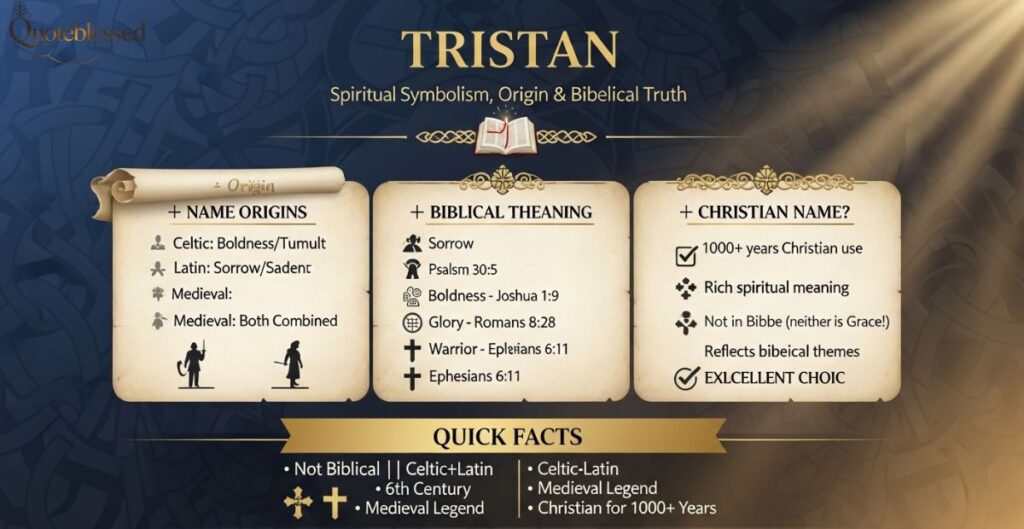
Tristan: Name Meaning & Legend
Origin & Meaning
Tristan comes from the Celtic/Welsh name Drystan or Tristram, likely derived from the Celtic word for “tumult” or “outcry.” Some sources connect it to the French word triste meaning “sad,” though this is probably a later folk etymology.
Hebrew connection: Tristan is not a Hebrew name and has no meaning in Hebrew. It’s of Celtic/French origin.
Greek connection: Not Greek in origin, though the name shares a similar sound to the Greek root trist- (sad). The name entered various European languages through medieval romance literature.
Biblical meaning: Tristan does not appear in the Bible and has no biblical significance. It’s a medieval literary name, not a scriptural one.
The Legend of Tristan and Isolde
One of the greatest tragic romances of medieval literature, the story tells of:
- Tristan, a knight sent to Ireland to escort the princess Isolde back to Cornwall to marry his uncle, King Mark
- During the voyage, Tristan and Isolde accidentally drink a love potion meant for the wedding night
- They fall helplessly in love but are bound by duty and honor
- Their forbidden love leads to betrayal, exile, and ultimately tragedy
- Multiple versions exist across French, German, and English traditions
The tale influenced countless works including Wagner’s opera and modern adaptations. It explores themes of passionate love versus duty, fate versus free will, and the destructive power of forbidden desire.
Is Tristan Mentioned in the Bible?
No, Tristan does not appear anywhere in the Bible. This is a medieval name that emerged centuries after biblical texts were written, with no connection to Hebrew, Aramaic, or Greek biblical names.
The True Origins of Tristan
The name has two competing etymologies, both rooted in medieval Europe—not in scripture:
1. The Celtic Theory (Most Likely)
- Derives from Drustan or Trystan in Old Welsh/Pictish
- Possibly connected to drest meaning “riot,” “tumult,” or “bold noise”
- Found in early British and Celtic legends before the famous romance tale
- This explains the name’s appearance in 6th-century Celtic sources
2. The Latin Theory (Later Folk Etymology)
- Associated with Latin tristis meaning “sad” or “sorrowful”
- This connection likely arose after the tragic romance became famous
- The sorrowful meaning fits the tragic love story, so it stuck
- Medieval storytellers may have reinforced this interpretation
Why the Confusion?
The name sounds biblical to modern ears because:
- It has a classical, ancient feel
- The “-an” ending resembles biblical names like Sebastian or Christian
- Its association with medieval Christian culture creates a false biblical connection
What Tristan Actually Represents
Rather than scripture, Tristan belongs to Arthurian romance and Celtic mythology:
- A knight of legendary courage and tragic fate
- Symbol of passionate, forbidden love
- Hero of one of literature’s greatest love stories
The takeaway: Tristan is a name of poetry and legend, not prophecy and scripture. Its power comes from medieval romance, not biblical roots.
Bible Verses That Reflect the Meaning of Tristan
While Tristan isn’t a biblical name, its dual meanings—sorrow/sadness (Latin tristis) and boldness/tumult (Celtic Drustan)—resonate deeply with scriptural themes. Here are verses that capture these contrasting elements:
Verses on Sorrow & Sadness
Psalm 34:18 “The Lord is close to the brokenhearted and saves those who are crushed in spirit.” A reminder that even in sorrow, God’s presence comforts us.
Matthew 5:4 “Blessed are those who mourn, for they will be comforted.” Sadness isn’t the end—God promises restoration and hope.
Psalm 30:5 “Weeping may stay for the night, but rejoicing comes in the morning.” Sorrow is temporary; joy follows suffering.
2 Corinthians 7:10 “Godly sorrow brings repentance that leads to salvation and leaves no regret.” Even sadness can serve a redemptive purpose.
Verses on Boldness & Courage
Joshua 1:9 “Be strong and courageous. Do not be afraid; do not be discouraged, for the Lord your God will be with you wherever you go.” Divine boldness in the face of tumult.
Proverbs 28:1 “The wicked flee though no one pursues, but the righteous are as bold as a lion.” True courage comes from righteousness.
Acts 4:29 “Enable your servants to speak your word with great boldness.” Spiritual courage to stand firm in faith.
Philippians 4:13 “I can do all things through Christ who strengthens me.” The source of supernatural boldness.
The Beautiful Paradox
The name Tristan embodies a biblical truth: God meets us in both our sorrow and our strength. We’re called to be bold warriors of faith while also embracing our brokenness before God. Like the biblical heroes—David, Job, Peter—we experience both grief and glory, both weakness and courage.
That’s the spiritual essence of Tristan: a name carrying both tears and triumph.
Spiritual Symbolism of the Name Tristan
Though Tristan has no biblical roots, it carries profound spiritual symbolism that resonates with Christian themes of suffering and strength, sorrow and redemption. The name embodies the human journey through darkness toward light.
The Duality of the Soul
Tristan represents the tension between pain and courage that defines spiritual growth. Just as Christians walk through valleys of shadow (Psalm 23) while being called to bold faith (Hebrews 11), the name reflects both our brokenness and our calling to rise above it.
Redemptive Suffering
The “sorrowful” meaning connects to Christ’s own path—“a man of sorrows, acquainted with grief” (Isaiah 53:3). Tristan symbolizes how suffering can be transformative rather than merely tragic, echoing the Christian belief that our trials produce perseverance and character (Romans 5:3-4).
Courageous Faith
The Celtic “boldness” meaning aligns with the spiritual warrior archetype found throughout Scripture—putting on the armor of God (Ephesians 6:10-18), fighting the good fight of faith (1 Timothy 6:12), and standing firm against spiritual tumult.
Is Tristan a Good Christian Name?
Yes, Tristan can be an excellent Christian name, despite not appearing in the Bible. Here’s why:
Names Don’t Need Biblical Origins
Many beloved Christian names aren’t biblical: Grace, Faith, Hope, Christopher, Christian, Sophia. What matters is the values and meaning behind the name, not whether it appears in Scripture.
It Reflects Christian Virtues
- Acknowledging sorrow: Christianity doesn’t ignore pain but transforms it
- Embracing boldness: Believers are called to courageous faith
- Honoring complexity: The Christian life includes both mourning and rejoicing
Historical Christian Use
Tristan has been used by Christian families for over 1,000 years across Europe. Medieval Christians saw no conflict between the name and their faith, often baptizing sons as Tristan with full ecclesiastical blessing.
A Name of Character
The legendary Tristan embodied loyalty, honor, and sacrificial love—qualities deeply aligned with Christian ethics, even if the story itself is secular romance.
The Real Question
Instead of asking “Is it biblical?” ask: “Does this name honor God and reflect values we want for our child?” By that measure, Tristan—meaning both humble sorrow and courageous strength—absolutely qualifies.
Tristan in Legend vs Biblical Truth
The tale of Tristan and Isolde offers a fascinating contrast to biblical teachings on love, duty, and morality. Understanding both enriches our perspective.
The Legend’s Core Narrative
Forbidden love: Tristan and Isolde fall passionately in love through a magic potion, but she’s betrothed to his uncle, King Mark. Their love is illicit, adulterous, yet portrayed as inevitable and noble.
Fate over choice: The potion removes their agency—they’re victims of destiny rather than moral actors making choices.
Tragic heroism: Their deception and betrayal are romanticized; death becomes their only honorable escape.
Biblical Truth: A Different Story
On Love and Marriage
The Bible upholds covenant faithfulness. While it acknowledges the power of attraction, Scripture calls us to honor commitments: “Marriage should be honored by all, and the marriage bed kept pure” (Hebrews 13:4).
The legend glorifies what the Bible calls sin—adultery that breaks covenant with God and others (Exodus 20:14).
On Free Will and Responsibility
Scripture rejects fatalism. We’re not puppets of destiny but moral agents: “Choose this day whom you will serve” (Joshua 24:15). The “love potion” removes the very thing God prizes most—our ability to choose righteousness.
On Suffering and Redemption
The Bible offers hope beyond tragedy. Where the legend ends in death and sorrow, biblical truth proclaims: “Weeping may endure for a night, but joy comes in the morning” (Psalm 30:5). Even our deepest failures can be redeemed through repentance and grace.
On True Love
Agape love (1 Corinthians 13) chooses sacrifice over selfishness. Biblical love serves others, keeps commitments, and reflects God’s faithful character—not the consuming passion that destroys kingdoms and families.
What We Can Learn
The Tristan legend is beautiful poetry but dangerous theology. It reminds us that:
- Passion without principle leads to destruction
- True love honors vows, even when feelings waver
- Our choices matter—we’re not slaves to fate or feeling
- Redemption is always possible through Christ, even after betrayal
The name Tristan can honor both the beauty of the legend and the truth of Scripture—acknowledging sorrow while choosing boldness, feeling deeply while acting righteously, and remembering that our stories don’t have to end in tragedy when we follow the Author of life.
Is the Name Tristan Found in the Bible?
No, the name Tristan does not appear anywhere in the Bible. Not in the Old Testament, New Testament, or Apocrypha. It’s not Hebrew, Aramaic, or Greek in origin, and it emerged centuries after the biblical canon was completed.
Tristan is a medieval European name born from Celtic legend and Latin influence—not from sacred Scripture. But that doesn’t diminish its spiritual significance or suitability for Christian families.
The Real Origin of Tristan—Celtic Roots Meet Christian Europe
Understanding Tristan’s true heritage reveals a fascinating collision of pagan mythology and Christian culture.
The Latin Connection
The most popular theory links Tristan to the Latin word tristis, meaning “sad” or “sorrowful.”
- This interpretation gained traction during the 12th-13th centuries when the romance of Tristan and Isolde swept across Europe
- Medieval French storytellers embraced this etymology because it perfectly matched the tragedy
- The name’s melancholic beauty resonated with courtly love traditions
- Christian monks copying these tales reinforced the “sorrowful” meaning
The catch? This might be reverse engineering—the tragic story influencing the etymology rather than the other way around.
The Celtic Alternative
The older and more likely origin traces to ancient Celtic Britain:
- Drustan or Trystan in Pictish and Old Welsh
- Possibly derived from drest, meaning “tumult,” “riot,” “noise,” or “bold clamor”
- Appears in 6th-7th century Welsh genealogies and Pictish king lists
- The hero Drust son of Erp ruled the Picts around 400-500 AD
This Celtic root suggests a warrior’s name—someone who brings upheaval, makes noise in battle, or acts with fierce boldness.
Medieval Synthesis
By the High Middle Ages, both meanings merged:
- The Celtic hero’s name was absorbed into Arthurian romance
- French troubadours added the tragic love story
- Latin-speaking clergy reinterpreted it through tristis
- Christian Europe adopted it as a name of noble suffering and courageous sorrow
The result? A name that carries both the warrior’s boldness and the martyr’s tears—a perfect emblem of Christian knighthood during the Crusades era.
Biblical Themes That Mirror Tristan’s Meaning
Though not in Scripture, Tristan’s dual meaning—sorrow and boldness—echoes throughout the biblical narrative.
Sorrow as Sacred Pathway
The Bible doesn’t avoid sadness; it sanctifies it.
Ecclesiastes 7:3 declares: “Sorrow is better than laughter, for by a sad countenance the heart is made better.”
Jesus himself was prophesied as “a man of sorrows, acquainted with grief” (Isaiah 53:3). His sorrow over Jerusalem (Luke 19:41), at Lazarus’s tomb (John 11:35), and in Gethsemane (Matthew 26:38) shows that godly people grieve deeply.
Paul wrote of being “sorrowful, yet always rejoicing” (2 Corinthians 6:10)—the exact paradox Tristan embodies.
Tumult and Divine Purpose
The Celtic “tumult” meaning aligns with how God often works through chaos and upheaval:
- Moses bringing tumult to Egypt through plagues
- Joshua’s battles creating turmoil in Canaan
- David the warrior-king, a man of blood and boldness
- The prophets stirring up nations with God’s word
- Jesus overturning tables and confronting religious hypocrisy
Hebrews 12:26-27 speaks of God shaking heaven and earth so that what cannot be shaken remains. Sometimes divine boldness creates necessary tumult.
From Grief to Glory
The most powerful biblical pattern is transformation through suffering:
- Joseph: from pit to palace (Genesis 37-50)
- Job: from ash heap to restoration (Job 42)
- David: from fugitive to king (1 Samuel-2 Samuel)
- The Israelites: from slavery to promised land (Exodus)
- Christ: from cross to resurrection (Philippians 2:8-11)
Romans 8:18 promises: “I consider that our present sufferings are not worth comparing with the glory that will be revealed in us.”
This is Tristan’s spiritual arc—sorrow that births courage, grief that produces glory.
Five Spiritual Symbols Embedded in Tristan’s Identity
Beyond etymology, the name carries deep symbolic layers for Christians.
1. Suffering as Sanctification
Tristan represents the biblical truth that affliction refines us:
“We also glory in our sufferings, because we know that suffering produces perseverance; perseverance, character; and character, hope.” (Romans 5:3-4)
Like gold tested by fire (1 Peter 1:7), the “sorrowful” Tristan becomes stronger, purer, holier through trials.
2. Redemptive Narrative Arc
Every Tristan carries the reminder that our stories don’t end in tragedy.
The legend ends in death, but Christian faith proclaims resurrection. Where the medieval tale offers only beautiful sorrow, the Gospel offers sorrow turned to joy (John 16:20), mourning turned to dancing (Psalm 30:11).
A child named Tristan symbolizes that God rewrites our endings.
3. Warrior Perseverance
The bold, tumultuous aspect connects to spiritual warfare:
“Fight the good fight of the faith. Take hold of the eternal life to which you were called.” (1 Timothy 6:12)
“Put on the full armor of God, so that you can take your stand against the devil’s schemes.” (Ephesians 6:11)
Tristan is a soldier’s name—someone who doesn’t flee tumult but faces it with holy courage.
4. Covenantal Faithfulness Over Emotion
Here’s where Tristan becomes instructive by contrast to the legend:
The medieval romance elevates passion above promises, desire above duty. But a Christian Tristan represents choosing covenant over feelings—keeping vows even when emotions waver, honoring commitments despite temptation.
“Love is patient, love is kind… it always protects, always trusts, always hopes, always perseveres.” (1 Corinthians 13:4-7)
The name becomes a reminder: we are more than our passions; we are people of promise.
5. Beauty From Ashes Restoration
Isaiah 61:3 promises God will give “beauty for ashes, the oil of joy for mourning, the garment of praise for the spirit of heaviness.”
Tristan—born from sorrow—becomes a living testimony to transformation. Every person bearing this name carries a prophetic declaration: God takes what begins in sadness and makes it glorious.
Tristan as a Christian Name—The Verdict
Can Christians use a name rooted in pagan Celtic legend and medieval romance? Absolutely. Here’s why.
What Makes Any Name “Christian”?
Not biblical origin—many beloved Christian names aren’t scriptural:
- Grace, Faith, Hope = English virtues, not Bible names
- Christopher = Greek for “Christ-bearer” (5th century invention)
- Christian = literally means “follower of Christ” (not used as a personal name in the Bible)
- Sophia = Greek philosophy term
- Trinity, Destiny, Serenity = theological/English concepts
The standard isn’t “Is it in the Bible?” but “Does it honor God and reflect Christian values?”
Historical Precedent
Tristan has been used by devout Christian families for over 1,000 years:
- Medieval knights named Tristan fought in the Crusades
- Saints and monks bore the name
- Christian royalty across England, France, and Germany chose it
- No church council, pope, or reformer ever condemned it
If centuries of faithful believers saw no problem, why should we?
Intention Matters Most
1 Corinthians 10:31 teaches: “Whatever you do, do it all for the glory of God.”
Naming a child Tristan with intention to raise them in faith, teaching them to turn sorrow into strength and to live boldly for Christ—that sanctifies the name.
It’s not the etymology that matters; it’s the destiny you declare over your child.
Practical Considerations
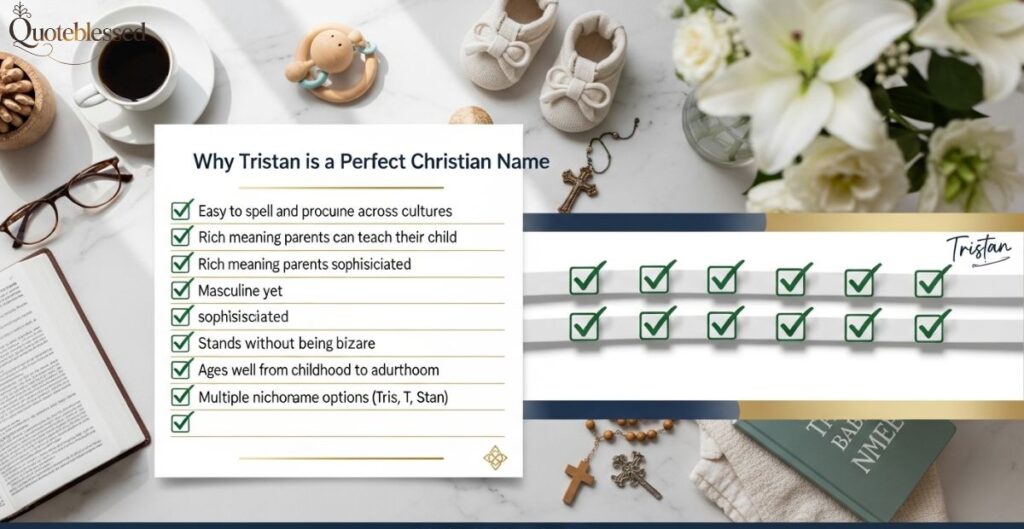
✅ Easy to spell and pronounce across cultures
✅ Rich meaning parents can teach their child
✅ Masculine yet sophisticated
✅ Stands out without being bizarre
✅ Ages well from childhood to adulthood
✅ Multiple nickname options (Tris, T, Stan)
Better Than Many “Biblical” Names
Honestly? Tristan carries more positive spiritual symbolism than some actual biblical names:
- Cain = murderer
- Jezebel = wicked queen
- Judas = betrayer
- Delilah = deceiver
- Nabal = fool
Being in the Bible doesn’t automatically make a name good. Tristan—despite being absent from Scripture—embodies redemptive suffering and holy courage.
The verdict: Tristan is an excellent Christian name. It honors both grief and glory, acknowledging human brokenness while celebrating divine strength.
Separating Medieval Legend from Biblical Truth
The Tristan and Isolde romance is beautiful literature—but dangerous theology. Christians must understand the difference.
The Legend’s Basic Plot
The setup: Tristan, a noble knight, is sent to Ireland to bring back the princess Isolde as a bride for his uncle, King Mark of Cornwall.
The complication: During the sea voyage, Tristan and Isolde accidentally drink a powerful love potion meant for the wedding night. They fall into irresistible, passionate love.
The conflict: Bound by honor to deliver Isolde to King Mark, Tristan completes his mission. She marries the king, but the lovers cannot suppress their feelings.
The tragedy: They conduct a secret affair, are discovered, flee into exile, suffer separation, and ultimately die—Tristan from wounds, Isolde from grief, collapsing on his body.
The message: True love transcends duty, morality, and even life itself. Passion is fate; resistance is futile.
Where the Legend Conflicts with Scripture
1. Adultery as Romantic Heroism
The legend glorifies what God condemns:
“You shall not commit adultery.” (Exodus 20:14)
“Marriage should be honored by all, and the marriage bed kept pure, for God will judge the adulterer and all the sexually immoral.” (Hebrews 13:4)
The Bible offers zero romantic spin on infidelity. Tristan and Isolde’s affair isn’t tragic nobility—it’s covenant-breaking that harms King Mark, their communities, and their own souls.
2. Fatalism Over Free Will
The magic potion makes their love involuntary and inevitable. But Scripture insists we have moral agency:
“Choose for yourselves this day whom you will serve.” (Joshua 24:15)
“No temptation has overtaken you except what is common to mankind. And God is faithful; he will not let you be tempted beyond what you can bear.” (1 Corinthians 10:13)
God doesn’t excuse sin because we feel powerless. We’re called to self-control (Galatians 5:22-23), not surrender to passion.
3. Death as the Ultimate Solution
The legend ends in beautiful tragedy—death unites what life kept apart.
But the Gospel proclaims resurrection and redemption:
“Where, O death, is your victory? Where, O death, is your sting?” (1 Corinthians 15:55)
Death isn’t romantic escape; it’s the enemy Christ conquered. The biblical pattern is repentance, restoration, and new life—not poetic suicide.
4. Emotion Trumps Covenant
The story elevates feelings over faithfulness. “I can’t help how I feel” becomes justification for betrayal.
Scripture teaches the opposite:
“Above all else, guard your heart, for everything you do flows from it.” (Proverbs 4:23)
“Take captive every thought to make it obedient to Christ.” (2 Corinthians 10:5)
We’re called to master our emotions, not be mastered by them.
Where It Aligns (Sort Of)
To be fair, the legend does contain some values Christians appreciate:
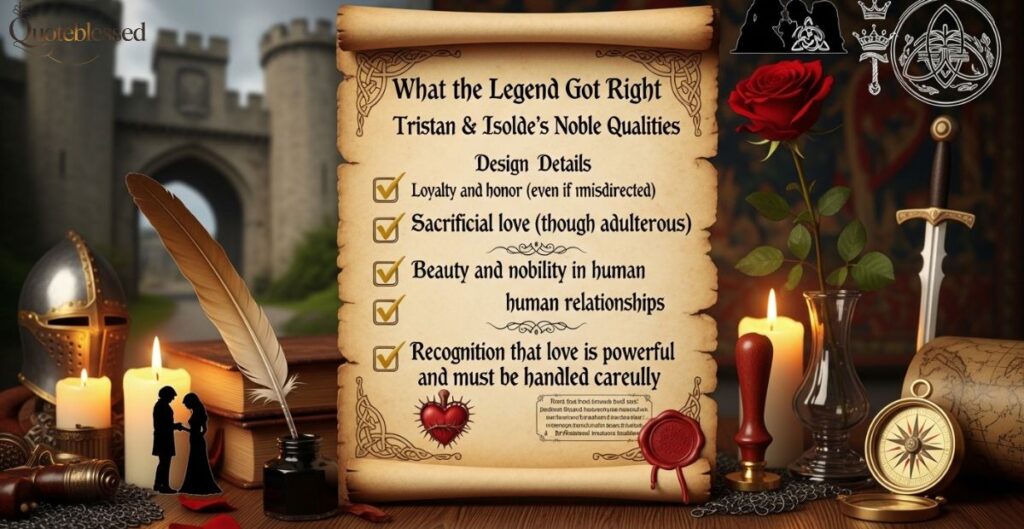
✅ Loyalty and honor (even if misdirected)
✅ Sacrificial love (though adulterous)
✅ Beauty and nobility in human relationships
✅ Recognition that love is powerful and must be handled carefully
The problem isn’t acknowledging passion’s power—it’s how we respond to it.
Redeeming Cultural Narratives
Christians don’t have to reject all secular literature. We can appreciate beauty while recognizing error:
- Read Shakespeare’s tragedies without endorsing revenge
- Enjoy Greek mythology without worshiping Zeus
- Appreciate Arthurian romance without adopting medieval sexual ethics
The key is discernment. Tristan and Isolde is a cautionary tale when viewed through biblical eyes—showing what happens when passion overrides principle.
How to Frame the Name’s Legacy
When raising a child named Tristan, redeem the narrative:
**”Your name comes from a famous legend about two people who loved deeply but made tragic choices. Their story reminds us that feelings are powerful, but God calls us to something higher—faithfulness, self-control, and covenant love that honors Him and others. You carry a name of both sorrow and strength. Let it remind you to choose wisely, love purely, and trust God even when emotions are overwhelming.”
This transforms the legend from romantic tragedy into moral lesson—exactly what biblical wisdom calls us to do with all cultural stories.
Bible Verses Perfect for a Child Named Tristan
These verses speak directly to the dual meaning of Tristan—sorrow and boldness—offering hope, strength, and purpose.
Jeremiah 29:11
“‘For I know the plans I have for you,’ declares the Lord, ‘plans to prosper you and not to harm you, plans to give you hope and a future.'”
Why it fits: Even if your name means “sorrow,” God’s plans for you are hopeful and good. Your story isn’t defined by sadness but by divine purpose.
Psalm 147:3
“He heals the brokenhearted and binds up their wounds.”
Why it fits: For the “sorrowful” meaning—God meets us in our deepest pain and brings healing. Tristan becomes a testimony to restoration.
2 Corinthians 4:17
“For our light and momentary troubles are achieving for us an eternal glory that far outweighs them all.”
Why it fits: Sorrow is temporary and purposeful. Present sadness is producing future glory—the very essence of redemptive suffering.
Romans 8:28
“And we know that in all things God works for the good of those who love him, who have been called according to his purpose.”
Why it fits: Even tumult, chaos, and sorrow serve God’s greater plan. Nothing is wasted in His economy.
Isaiah 43:2
“When you pass through the waters, I will be with you; and when you pass through the rivers, they will not sweep over you. When you walk through the fire, you will not be burned; the flames will not set you ablaze.”
Why it fits: For the “tumult” meaning—God walks with us through chaos and upheaval. Boldness comes from His presence, not our strength.
James 1:12
“Blessed is the one who perseveres under trial because, having stood the test, that person will receive the crown of life that the Lord has promised to those who love him.”
Why it fits: Tristan embodies perseverance through difficulty. Enduring sorrow and tumult produces eternal reward.
Matthew 17:20
“Truly I tell you, if you have faith as small as a mustard seed, you can say to this mountain, ‘Move from here to there,’ and it will move. Nothing will be impossible for you.”
Why it fits: For the “boldness” meaning—courageous faith moves mountains. A child named Tristan can live with holy audacity, trusting God for impossible things.
Final Thought:
Tristan may not be in the Bible, but it embodies a deeply biblical truth: God transforms our sorrow into strength, our grief into glory, and our tumultuous journeys into testimonies of His faithfulness. It’s a name that declares, “I will grieve honestly and fight courageously, trusting that my story ends not in tragedy, but in triumph.”

Umair is the founder and content creator behind QuoteBlessed.com. With a passion for spreading positivity, inspiration, and meaningful blessings, he writes heartfelt quotes, wishes, and motivational messages to uplift readers around the world.
Through his work, Umair aims to create a platform where words inspire hope, faith, and happiness in everyday life. He focuses on delivering authentic, human-written content that connects deeply with his audience while maintaining quality, trust, and relevance.